Overview
Primary Goal: Increase product understanding for global audiences accessing REMEDI's medical technology products.
Key Constraint: No formal user feedback or testing data was available at the time of launch. This project was approached as a v1 hypothesis requiring subsequent validation.
Problem
REMEDI's previous website struggled with:
- Product-centric organization: Content was structured around internal product categories rather than user needs or clinical use cases.
- Hidden technical proof: Scientific validation, certifications, and clinical evidence were buried or disconnected from product information.
- Unclear pathways to action: Users interested in trials, purchases, or inquiries faced ambiguous or redundant CTAs.
- Global audience barriers: Language, cultural context, and trust signals were not prioritized for international medical professionals.
Approach
1. Use-Case-First Information Architecture
I restructured the site around clinical and operational use cases rather than product SKUs. For example, instead of "Product A" and "Product B," the navigation highlights scenarios like "Emergency Diagnostics," "Routine Screening," or "Point-of-Care Testing."
Rationale: Medical professionals and procurement decision-makers think in terms of problems to solve, not product names. Use-case entry points reduce cognitive load and improve discoverability.
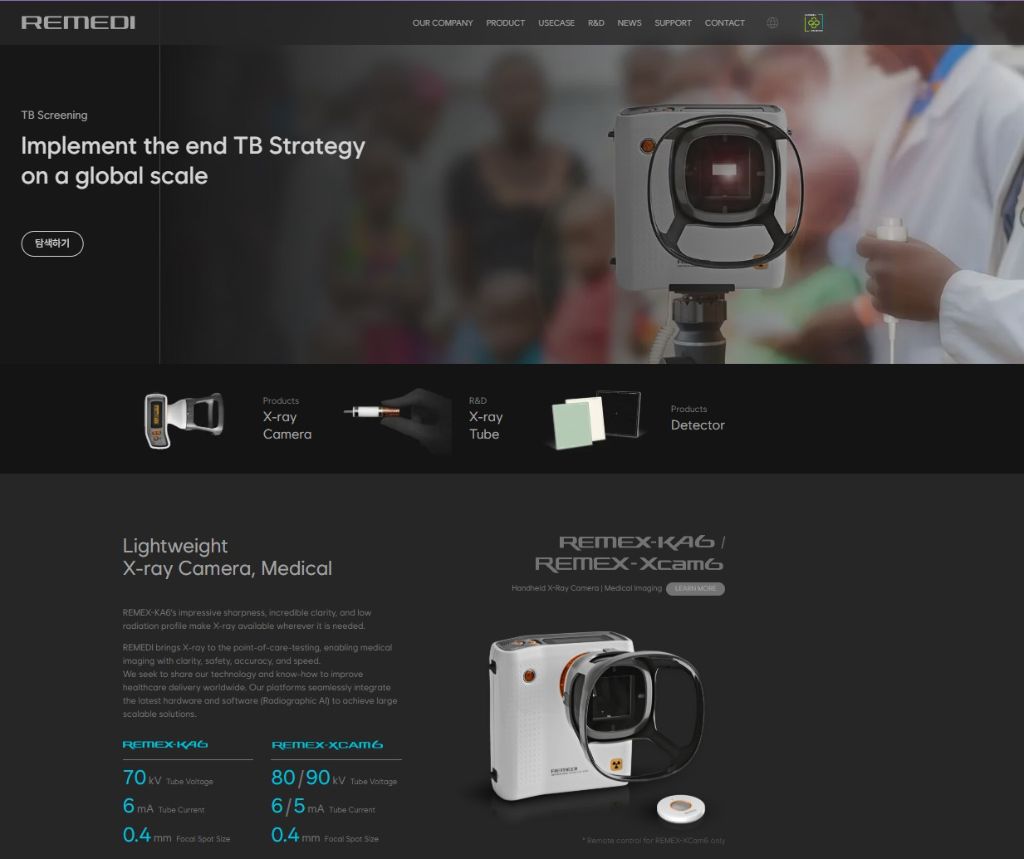
Product-centric view: REMEX-KA6 and REMEX-XCam6 lightweight X-ray cameras with technical specifications
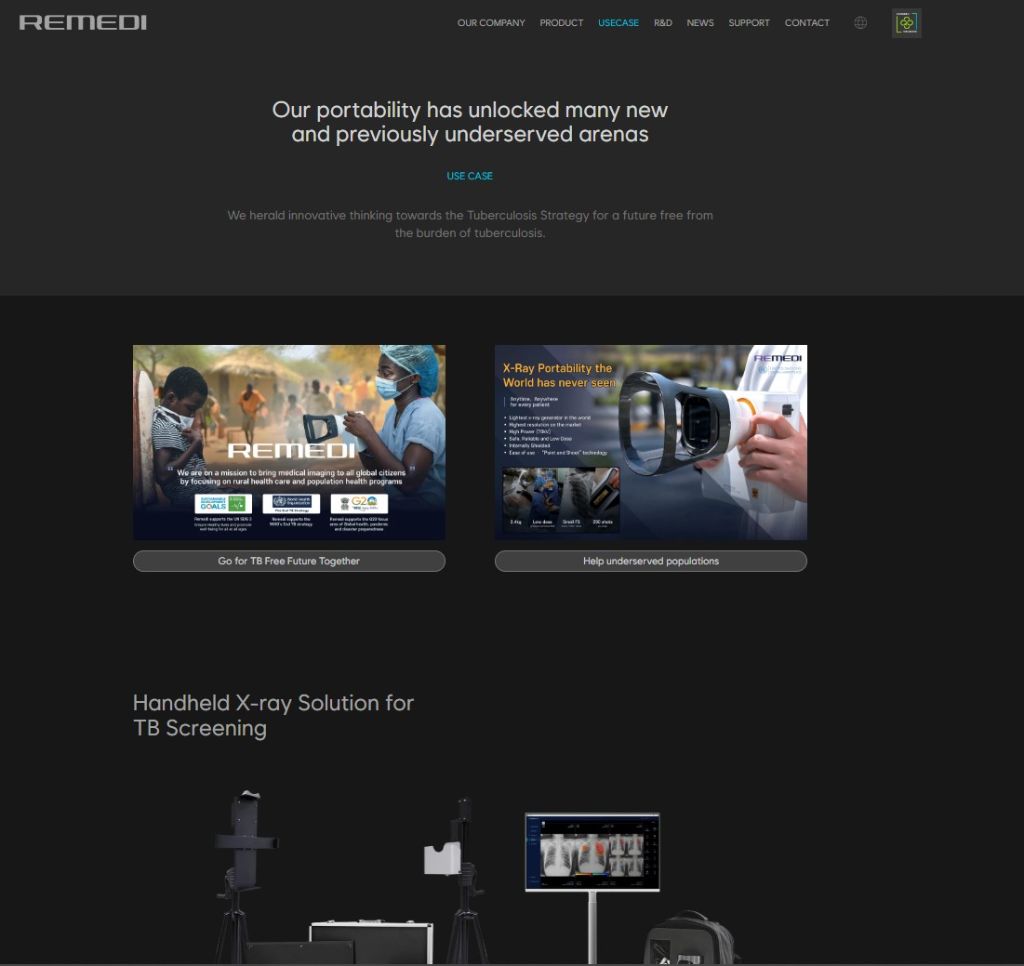
Use-case view: Tuberculosis screening applications highlighting portability and underserved populations
2. Content Model: Use Case → Product → Technical Proof → CTA
Each pathway follows a consistent flow:
- Use Case: What clinical or operational need does this address?
- Product: Which REMEDI solution fits this need?
- Technical Proof: What is the scientific evidence, certification, or validation?
- CTA: Clear next step (Request Demo, Contact Sales, Download Spec Sheet).
This model surfaces trust signals (peer-reviewed studies, regulatory approvals) alongside product features, not as afterthoughts.
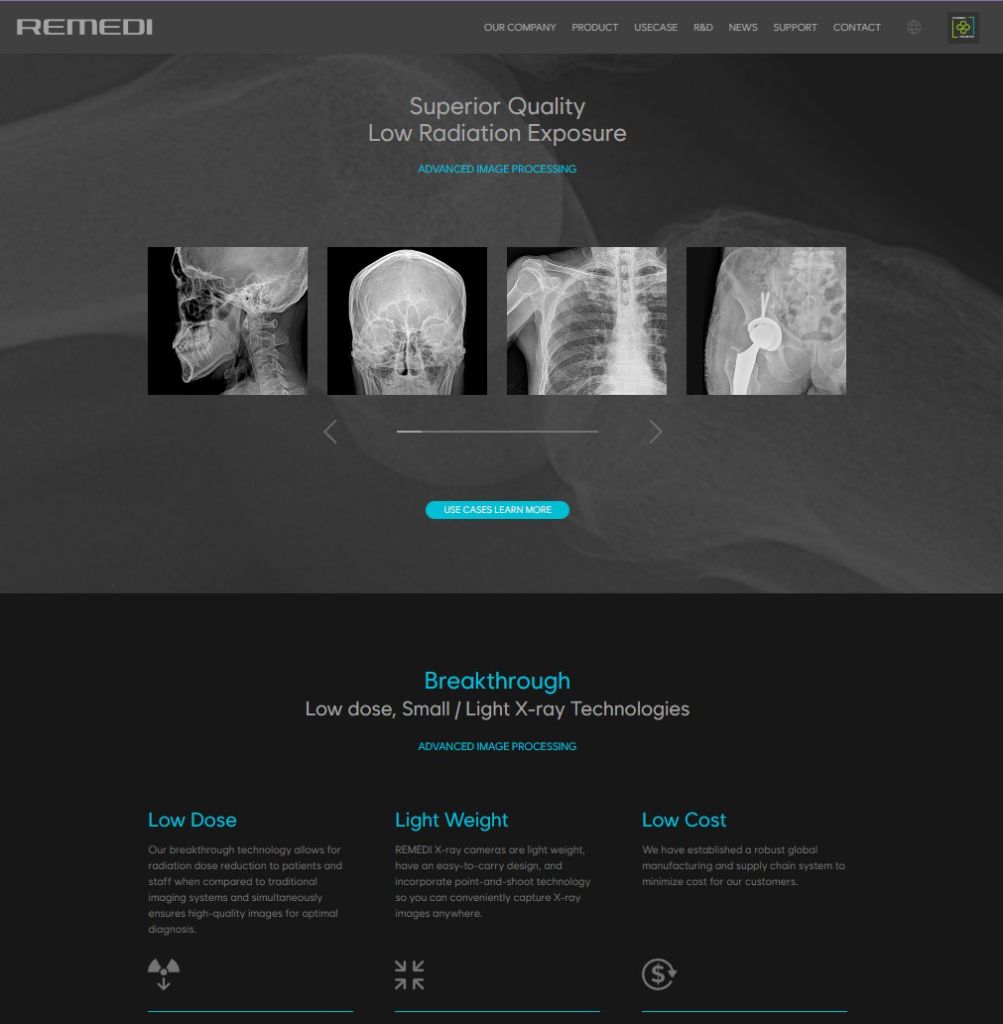
Technical proof: Superior image quality and low radiation exposure demonstrations with real X-ray samples
3. Clarity and Trust for Global Audiences
- Simplified language: Avoided jargon where possible; defined technical terms inline.
- Visual hierarchy: Used typography, whitespace, and progressive disclosure to make dense information scannable.
- Localization readiness: Designed content structure to support multiple languages and cultural adaptations.
- Trust signals: Positioned certifications (FDA, CE), peer-reviewed publications, and institutional partnerships prominently.
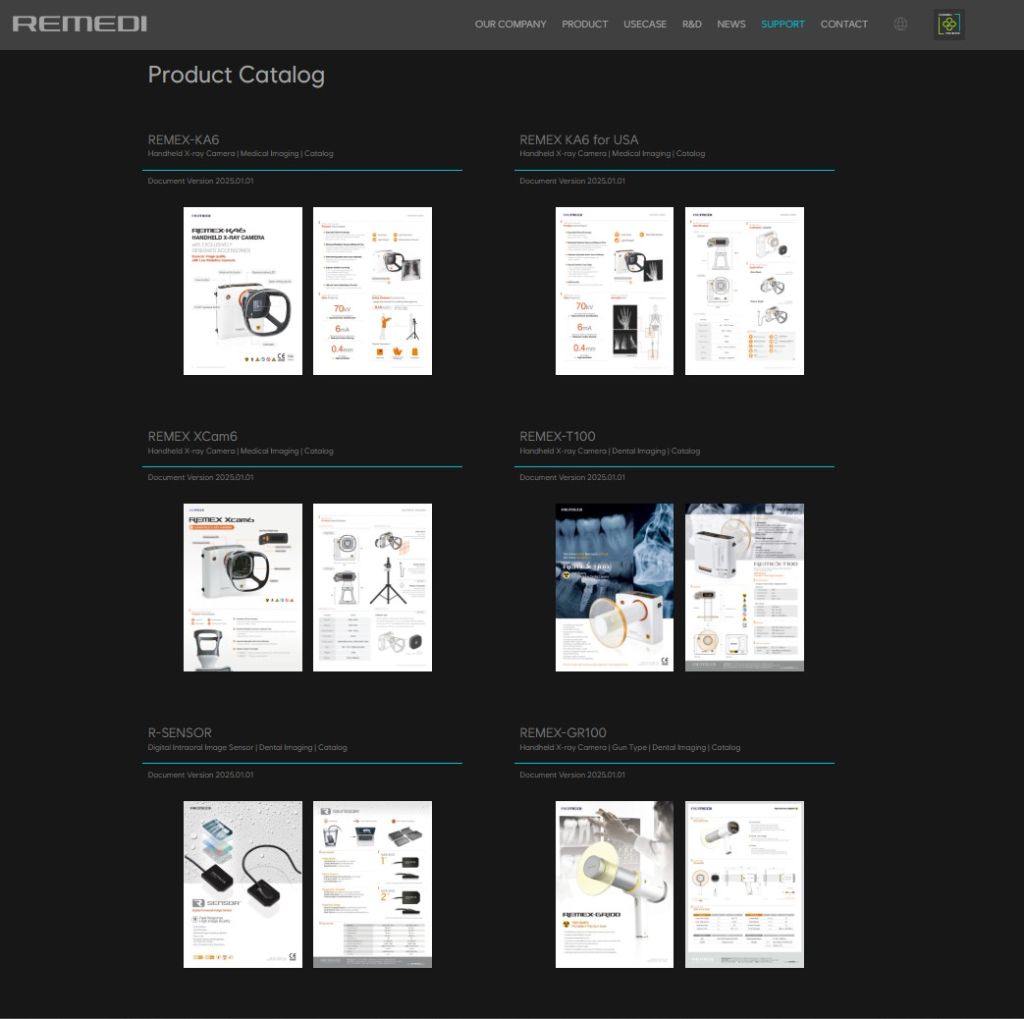
Comprehensive product catalog: REMEX-KA6, REMEX-KA6 for USA, REMEX-XCam6, REMEX-T100, R-SENSOR, and REMEX-GR100
Evidence Statement
No formal usability testing data was available at the time of launch. I treated this as a v1 hypothesis and defined a validation plan for the next iteration (analytics + stakeholder interviews + lightweight usability tests focused on comprehension and decision confidence).
Validation Plan (Post-Launch)
To assess whether the redesign improves product understanding and conversion, I proposed the following:
Analytics (Quantitative Proxies)
- Time on key pages: Are users spending more time on product detail pages (suggesting engagement) or bouncing quickly?
- Navigation paths: Do users follow the intended use-case → product → proof → CTA flow, or do they get lost?
- CTA click-through rates: Are inquiry forms, demo requests, or spec sheet downloads increasing?
- Search behavior: What are users searching for? Does site search reveal unmet information needs?
Stakeholder Interviews (Qualitative)
- Interview 5–8 internal stakeholders (sales, clinical specialists, customer support) who interact with prospects.
- Ask: Are prospects asking fewer clarifying questions? Are they arriving at sales calls better informed?
Lightweight Usability Tests (Task-Based)
- Recruit 6–8 target users (e.g., hospital procurement officers, lab technicians, clinicians).
- Task: "Find a product suitable for emergency diagnostics and determine if it meets regulatory requirements for your region."
- Measure: Task success rate, time to complete, confidence ratings, and comprehension (ask participants to explain product suitability in their own words).
Decision Confidence Metric
After completing tasks, ask participants: "On a scale of 1–7, how confident are you that you understand this product's capabilities and suitability for your needs?" Responses ≥5 suggest the design supports informed decision-making.
Outcomes & Reflection
What was delivered: A fully redesigned website with use-case-first IA, streamlined content model, and trust-forward design. The site launched on schedule and is live at remedihc.com/en.
What I would do next:
- Execute the validation plan to measure comprehension, navigation success, and decision confidence.
- Iterate based on findings—potentially adding comparison tools, interactive product selectors, or more granular use-case filtering.
- Conduct A/B tests on CTA placement and wording to optimize conversion.
Reflection: This project reinforced my belief that design is hypothesis-driven. Even without pre-launch testing, I made informed assumptions grounded in user research principles (use-case thinking, trust signals, clear CTAs) and documented a clear path to validate those assumptions. In a tenure-track role, I would teach students this same approach: design with intent, document your rationale, and always plan for evidence gathering—even if it happens post-launch.
Role & Responsibilities
As overall lead and end-to-end owner, I was responsible for:
- Information Architecture: Mapped user needs to content structure; designed use-case-first navigation.
- Content Strategy: Defined content model (use case → product → proof → CTA); wrote content guidelines for clarity and trust.
- Design Direction: Created wireframes, specified interaction patterns, and reviewed all visual design deliverables.
- Development Coordination: Worked with developer to ensure technical feasibility and fidelity to design intent.
- Project Management: Managed timeline, stakeholder communication, and scope across a 6-month project.
- Validation Planning: Proposed analytics setup, interview protocols, and usability test scenarios for post-launch evaluation.
Key Artifacts
- Information architecture sitemap (use-case-first structure)
- Content model documentation (use case → product → proof → CTA flow)
- Wireframes and interaction specs
- Validation plan (analytics, interviews, usability testing)
- Live website: remedihc.com/en
Supporting project artifacts (diagrams, wireframes, research documentation) are available upon request.